Predator richness and prey genetic diversity co-determine prey rapid evolution
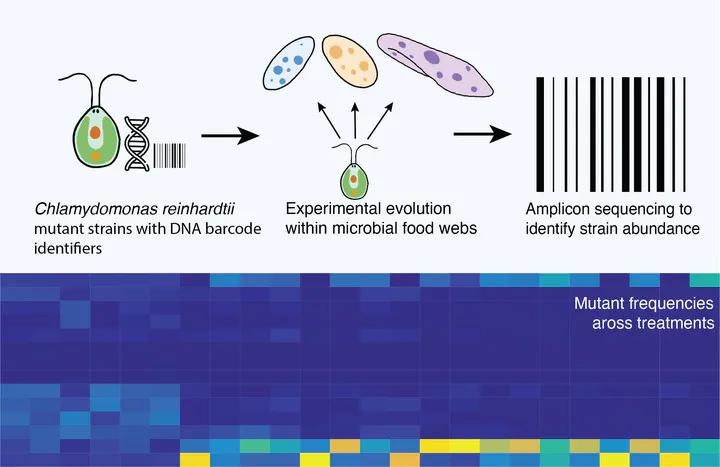
Ecologists have long been fascinated by variations at different organizational levels. Species-level variation enable evolution and community-level variation, such as species diversity, influence community and food web dynamics. However, the evolutionary implications of variation across trophic levels remain poorly understood. To address this gap, we leveraged a state-of-the-art mutant library of the green alga Chlamydomonas reinhardtii, comprising thousands of strains with described mutations and unique DNA barcodes, allowing for strain identification and quantification of contemporary changes of gene frequencies (i.e. rapid evolution). We set up tractable microbial food webs using these mutants as prey and multiple ciliate protists as predators to ask: how do prey standing genetic variation and predator species richness jointly affect prey evolution at both the genetic and cellular functional level? We manipulated prey genetic variation and predator richness. We used use flow cytometry to track C. reinhardtii population density and amplicon sequencing to track the mutant strain frequencies.
Our preliminary results indicate that genetic diversity increases prey population density regardless of the presence and absence of predators. Predation decreased the additive genetic variation of C. reinhardtii. Contrary to previous research suggesting that complex food webs weaken species interactions and impose less selective pressure, our results revealed that increased food web complexity with high predator richness leads to reduced additive genetic variation, indicating strong selective pressures favoring specific genetic variants and more constrained evolutionary outcome.
This project is ongoing—stay tuned for updates!