Food-web context determines evolutionary responses to warming
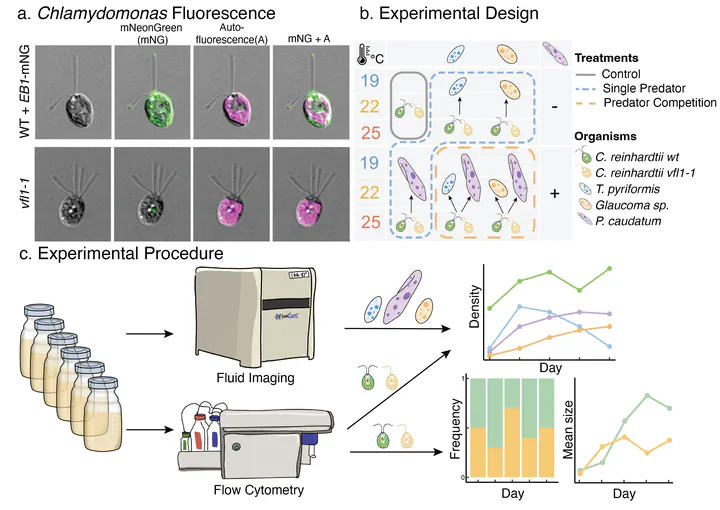
Understanding microbial responses to global warming is a pressing goal as microbes play major roles in the global carbon cycle. While the evolutionary responses have been heralded as a buffer against rapid climate change, we lack a clear understanding of how climate-driven evolution actually occurs within the complex microbial food webs in which all microbes are embedded in. Here, we used a combination of evolution assays in microbial microcosms, mathematical modeling, and novel applications of cell biology tools to close the gap.
Our study uncovers that temperature alone does not drive prey rapid evolution unless predators are involved. Additionally, temperature effects on predator thermal performance and prey plasticity can both influence the prey evolutionary process. Our results highlight that similar species might show different evolutionary responses to rising temperatures, and that temperature effects on biotic interactions likely play a key role in determining species evolution in warming food webs.